Mass Spectrometry Facility
|
Principal
Investigator: |
|
MS Laboratory Supervisor: |
Lab Location: Polk Hall 42
Lab Phone: 919-515-0831
Biological Mass Spectrometry Overview
Mass spectrometry is a powerful technique used frequently for both qualitative and quantitative characterization of proteins and other biomolecules as well as their interactions. In a typical MS experiment, molecules are ionized, accelerated into a mass analyzer, separated on the basis of mass-to-charge ratio (m/z), and detected. In another type of experiment known as MS/MS, one or more "precursor" ions are fragmented inside a collision cell in the mass spectrometer, and the resulting "product" ions mass analyzed. The resulting product ion spectrum may be used to provide insights into molecular structure based on the pattern of product ions generated. In combination with other techniques such as liquid chromatography, gel electrophoresis, chemical crosslinking, and co-immunoprecipitation, a variety of complex biological problems may be addressed.
Research
The mass spectrometry facility in Molecular and Structural Biochemistry is used to support a variety of research efforts through collaboration with Dr. Goshe. Although not a fee-for-service core facility, a large number of collaborative efforts are supported for faculty across departments and colleges, including generation of preliminary data in support of planned grant submissions on a case by case basis. Ongoing efforts can be broadly categorized as follows.
Proteomics: Characterization of the composition and dynamics of proteomes in plant and animal systems using a variety of approaches including label-free quantitation, SILIP, SILAC, and other custom labeling techniques. Determination of protein interaction partners through the use of co-immunoprecipitaton and other affinity based techniques.
Characterization of Post-Translational Modifications: Site assignment and quantitative characterization of post-translational modifications including phosphorylation, ubiquitination, and others. Site-specific stoichiometry measurements in response to various stimuli or environmental conditions may be determined.
Protein Structure: Through the use of a variety of novel chemical crosslinking reagents, protein-protein interactions are studied. Insights into protein structure and folding may be obtained through the analysis of individual proteins following chemical crosslinking. Similarly, intramolecular disulfide bonding patterns within proteins may be determined by MS. In addition, quantitative compositional analysis of protein macromolecular complexes often provides insights into the structure and function of the complex or individual components.
Facilities
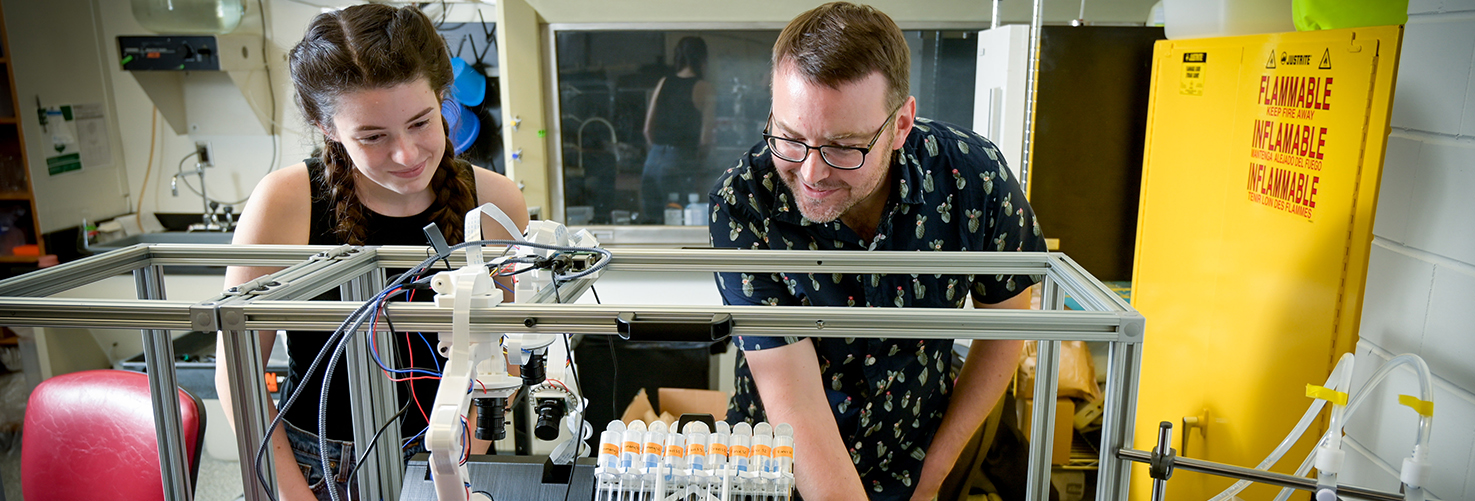
The mass spectrometry laboratory located in the basement of Polk Hall is comprised of approximately 1100 square feet of customized space including electrical, ventilation, and specialty gases for mass spectrometry equipment. Two additional wet labs of approximately 900 square feet located on the 1st floor of Polk Hall are used for sample prep.

Instrumentation
|
Waters NanoAcquity UPLC and Q-Tof PremierUPLC (Ultra-Performance Liquid Chromatograph) for nanoscale LC separations at up to 10,000 psi. Q-Tof Premier MS uses ESI for LC/MS, LC/MS/MS, or LC/MSE analyses. MALDI ionization is also available on this instrument. Maximum mass resolution is 17,500 FWHM in W-mode, with mass errors of < 5 ppm with nanolockspray. |
|
Waters CapLC and Q-Tof API-USCapLC for nanoscale or capillary LC separations. Q-Tof API-US MS uses ESI for LC/MS or LC/MS/MS analyses. Infusion studies are also conducted on this instrument. Maximum mass resolution is 10,000 FWHM in W-mode. |
|
Thermo Finnigan TSQ-QuantumTriple quadrupole MS capable of a variety of MS/MS experiments including product ion scanning, precursor ion scanning, selected reaction monitoring (SRM), and multiple reaction monitoring (MRM). |
|
Agilent 1100 CapLC and Finnigan LCQ Deca (2 systems)Agilent 1100 for high-resolution capillary LC separations coupled to a Finnigan LCQ Deca ion trap MS via a custom nanospray ion source. These instruments are capable of multi-stage MS/MS experiments (MSn) providing unique capabilities for characterization of PTMs such as phosphorylation and glycosylation. An additional LCQ Deca XP is also available. |
Outreach
September, 2009 — Scouts from Boy Scout Troop 55 and Cub Scout Pack 91 recently visited the Mass Spectrometry and X-ray Crystallography Facilities. The boys toured both laboratories and participated in a variety of hands-on activities and experiments demonstrating how chemistry is involved in their everyday lives. For their participation, the Boy Scouts earned their Chemistry Merit Badge while the Cub Scout earned his Science Belt Loop.
![]() |
![]() |
![]() |
![]() |
Useful Links
Professional Associations
- Triangle Area Mass Spectrometry Discussion Group (http://biochem.ncsu.edu/TAMS/)
- American Society for Mass Spectrometry (http://asms.org)
- Association for Biomolecular Resource Facilities (http://www.abrf.org)
- Human Proteome Organization (http://www.hupo.org)
Research Institutes
- Pacific Northwest National Lab (PNNL) (http://ncrr.pnl.gov)
- Institute for Systems Biology (ISB) (www.systemsbiology.org)
- Broad Institute (http://www.broadinstitute.org)
Protein and Proteomic Databases and Related Tools
- Matrix Science (Mascot) (http://www.matrixscience.com)
- ProteinProspector (http://prospector.ucsf.edu/prospector/mshome.htm)
- The Global Proteome Machine Organization (http://www.thegpm.org)
- Peptide Atlas (http://www.peptideatlas.org)
- PRIDE Proteomics IDEntifications database (http://www.ebi.ac.uk/pride)
- KEGG Pathways (http://www.genome.jp)
- PhosphoSitePlus (http://www.phosphosite.org/homeAction.do)
- ExPASy Proteomics Server (http://ca.expasy.org)
- PSORT (http://psort.ims.u-tokyo.ac.jp)
Tutorials
Introduction to Protein Chemistry: Overview of protein chemistry and analytical strategies used in conjunction with mass spectrometry for protein characterization. (Courtesy of Dr. Doug Sheeley, National Center for Research Resources, NIH)
Introduction To Mass Spectrometry: Overview of ion sources and mass analyzers used for protein characterization. (Courtesy of Dr. Doug Sheeley, National Center for Research Resources, NIH)
Peptide Sequencing by Mass Spectrometry: Overview of peptide fragmentation behavior and de novo sequencing by mass spectrometry. (Courtesy of Kevin Blackburn, NCSU Biochemistry)
Protein Identification by Database Searching: Overview of protein identification through database searching of mass spectrometry data. (Courtesy of John Cottrell, Matrix Science, Ltd.)
Fundamentals of Proteomics: An overview of the applications of mass spectrometry and related technologies to the field of proteomics. (Courtesy of Dr. Arthur Moseley, Duke University Proteomics Core Facility)
Introduction to Quantitative Proteomics: An overview of mass spectrometry based strategies for the quantitative characterization of proteome samples. (Courtesy of Dr. Arthur Moseley, Duke University Proteomics Core Facility)
Analysis of Intact Proteins by MS: An overview of the characterization of purified intact proteins by mass spectrometry. (Courtesy of Kevin Blackburn, NCSU Biochemistry)
Introduction to Phosphorylation Analysis by MS: An overview of mass spectrometry based phosphorylation site analysis. (Courtesy of Kevin Blackburn, NCSU Biochemistry)